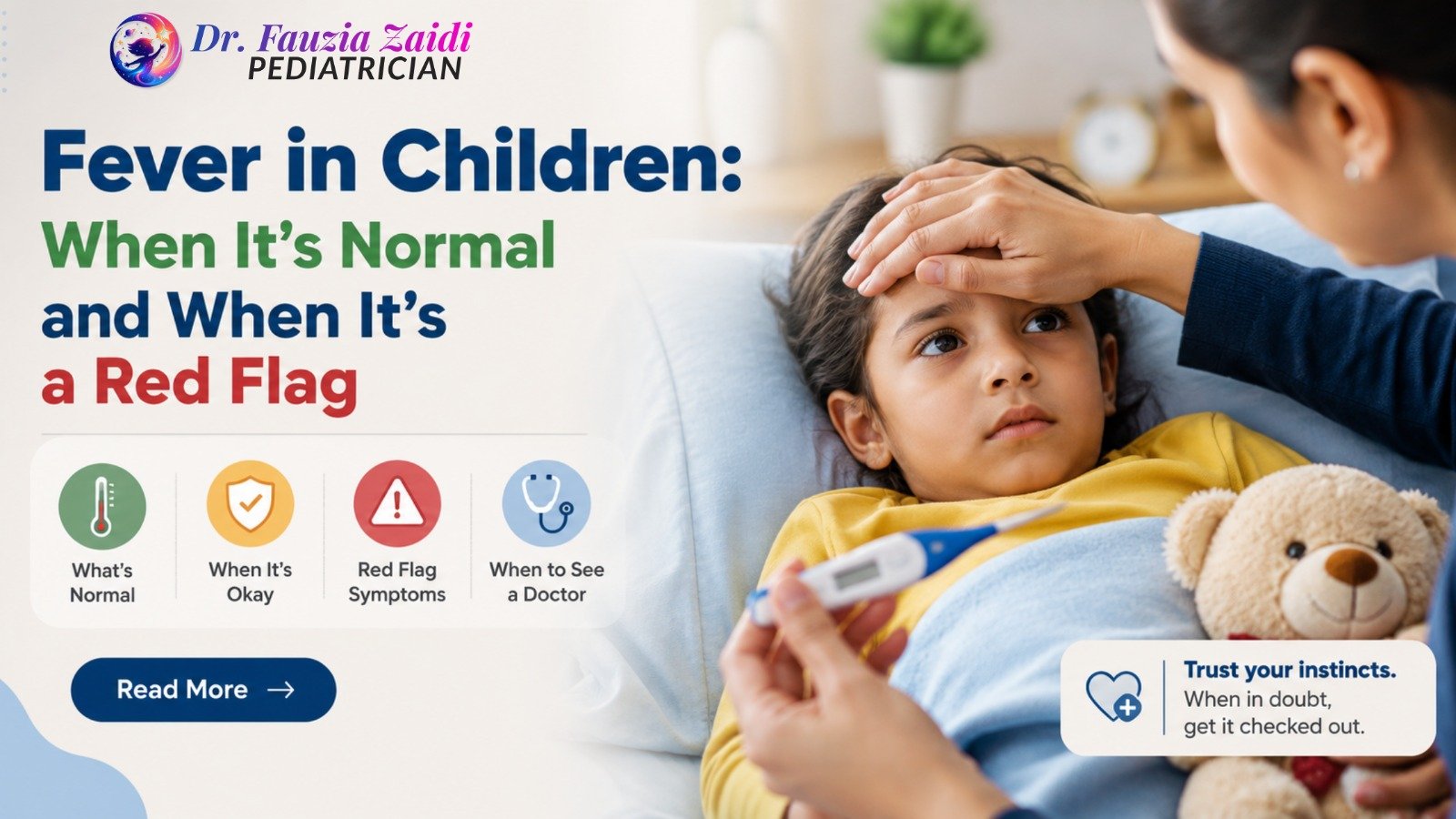







Fever in Children: When It's Normal and When It's a Red Flag
Every parent knows that heart-drop moment — you touch your child's forehead, and it's warm. Too warm. Your mind starts racing through worst-case scenarios before you've even reached for the thermometer. Take a breath. Fever, in most cases, is not the enemy. It's actually your child's immune system doing exactly what it's supposed to do.
But knowing the difference between "this will pass" and "we need to see a doctor right now" can be confusing, especially at 2 a.m. with a cranky, warm toddler in your arms. This guide breaks it down simply, so you can respond with confidence instead of panic.
What Is Fever, Really?
Fever is defined as a body temperature above 100.4°F (38°C). It isn't an illness itself — it's a symptom, a sign that your child's body is actively fighting off an infection, usually viral. The brain raises body temperature deliberately because many germs struggle to survive in a warmer environment. In short, fever is often a helper, not a threat.
When Fever Is Normal
Most fevers in children are harmless and resolve within 2–3 days. You can generally consider it "normal" territory when:
Your child is alert, playful, and drinking fluids between fever spikes
The temperature responds to paracetamol or ibuprofen
There are mild cold symptoms — runny nose, slight cough, or sore throat
Your child is eating less but not refusing fluids
The fever appears after a vaccination (this is a common, expected reaction)
In these situations, home care is usually enough: light clothing, plenty of fluids, rest, and fever-reducing medicine if your child is uncomfortable. Many parents searching for reassurance instead of medication often find that simply monitoring symptoms closely for 24–48 hours brings clarity.
When Fever Becomes a Red Flag
This is where parental instinct matters most. Trust that nagging feeling that something is "off." Seek medical attention immediately if you notice:
Fever in infants under 3 months — any fever in this age group needs urgent evaluation
Temperature above 104°F (40°C) that doesn't respond to medication
Fever lasting more than 3 days without improvement
Lethargy or extreme difficulty waking the child
Persistent vomiting or refusal to drink fluids, risking dehydration
A rash that doesn't fade when pressed
Stiff neck, severe headache, or sensitivity to light
Seizures (febrile convulsions), even if brief
Difficulty breathing or fast, laboured breaths
Signs of dehydration — dry lips, no tears, reduced urination
If even one of these red flags appears, don't wait for it to go out. Parents in and around the area often consult the Best Child Specialist in Sector 46, Noida. precisely because early evaluation can prevent complications that develop quickly in young children.
Why Age Matters So Much
A 6-month-old and a 6-year-old don't carry the same risk with the same fever. Newborns and infants have immature immune systems, making even a mild fever potentially significant.
Toddlers and older children, on the other hand, can often tolerate fever fairly well as long as they remain active and hydrated. This is why paediatricians always ask the child's exact age before advising over the phone — context changes everything.
Practical Tips for Parents at Home
Use a reliable thermometer — digital ones under the arm or in the ear are accurate and gentle.
Dress your child lightly — heavy blankets trap heat and worsen discomfort.
Offer fluids frequently — water, ORS, or breastmilk for infants.
Avoid sponging with cold water — it can cause shivering, which raises the temperature further.
Track the pattern — note when the fever spikes and how it responds to medicine; this helps your doctor diagnose faster.
When in Doubt, Don't Guess — Ask
Parenting forums and well-meaning relatives often offer conflicting fever advice. While most of it comes from good intentions, fever management isn't a one-size-fits-all situation. If your gut tells you something isn't right, it's always safer to get a professional opinion. This is exactly the kind of moment when having a trusted, experienced doctor on speed dial makes all the difference. Many families consider the Best Child Specialist in Sector 46, Noida, as their go-to support during such uncertain nights, simply because timely guidance offers peace of mind that no internet search can replace.
A good paediatrician doesn't just treat the fever — they look at the whole child: behaviour, hydration, breathing pattern, and history, before deciding the next step. That's the kind of holistic, experience-backed care the Best Child Specialist in Sector 46, Noida. It is known among local parents.
The Bottom Line
Fever is rarely something to fear — it's usually a sign that your child's body is working hard to heal itself. Most fevers are short-lived and manageable at home with comfort care and observation. However, certain warning signs demand swift medical attention, especially in very young infants.
When uncertainty creeps in, don't second-guess yourself into inaction. Reaching out to the Best Child Specialist in Sector 46, Noida. A timely check-up can offer both clarity and reassurance — because when it comes to your child's health, "better safe than sorry" is always the right approach. Whether it's a routine viral fever or something that needs closer attention, consulting the Best Child Specialist in Sector 46, Noida. ensures your little one gets accurate, age-appropriate care without delay.
Frequently Asked Questions
1. Is a fever of 99°F a cause for concern?
No, that's a mild elevation, not a true fever. Monitor your child comfortably.
2. Can teething cause fever in babies?
Teething may cause mild warmth, but a true fever usually means another cause.
3. Should I wake my sleeping child to give fever medicine?
No, let them sleep — rest helps recovery; medicate when they wake.
4. How long can a viral fever last in kids?
Typically 2–3 days; beyond that, consult a paediatrician.
5. Are febrile seizures dangerous long-term?
Most are brief and harmless, but should always be medically evaluated.
.png)